
BIM Companies in Canada: List of BIM Outsourcing Providers
- 1. Why Are BIM Companies in Canada Highly Regarded?
- 1.1. A Steadily Maturing North American BIM Market
- 1.2. No National BIM Mandate — But Growing Procurement Pressure
- 1.3. Regional Variation in Adoption
- 2. BIM Standards Shaping the Canadian Market
- 2.1. buildingSMART Canada as the National Standards Body
- 2.2. ISO 19650: The De Facto Information Management Standard
- 2.3. OpenBIM Adoption
- 3. A Verified Shortlist: Top BIM Companies in Canada
- 3.1. Stantec
- 3.2. WSP Canada
- 3.3. PCL Construction
- 3.4. EllisDon
- 3.5. AECOM Canada
- 3.6. Hatch
- 3.7. Comparison Table
- 4. How to Choose the Right BIM Company in Canada
- 4.1. Technical Capability
- 4.2. Standards and Information Management
- 4.3. Project Experience Relevant to Scope
- 4.4. QA/QC and Model Validation
- 4.5. Coordination and Communication
- 5. Notes When Placing a Custom BIM Outsourcing Order
- 6. Frequently Asked Questions
- DHA ENGINEERING — Your International BIM Outsourcing Partner
- DHA Vietnam Engineering Co., Ltd.
As the global construction industry accelerates its digital transformation, Building Information Modeling (BIM) has become one of the core technology platforms for improving design accuracy, construction coordination, and facility management. Canada is one of the countries actively driving BIM adoption — not through a single national mandate, but through professional bodies, provincial procurement requirements, and a wave of large-scale infrastructure investment.
1. Why Are BIM Companies in Canada Highly Regarded?
1.1. A Steadily Maturing North American BIM Market
Canada is one of the more established BIM markets in North America, shaped by large residential, industrial, and transportation infrastructure programs and by close collaboration between government bodies, professional associations, and private engineering firms. Many Canadian firms today deliver BIM work not only domestically but for projects in the United States, Europe, the Middle East, and Asia-Pacific, across sectors including hospitals, airports, data centers, transportation infrastructure, and energy facilities.
1.2. No National BIM Mandate — But Growing Procurement Pressure
Unlike the United Kingdom, which has required Level 2 BIM on all centrally-funded public projects since April 2016, or the United States, where the General Services Administration has required BIM on major federal building projects since 2007, Canada has no single, nationwide BIM mandate. Industry leaders at buildingSMART Canada have been explicit about why: Canada's built-environment sector is governed across multiple, overlapping federal, provincial, and municipal jurisdictions, which makes a single top-down mandate — of the kind Denmark, Norway, or the UK adopted — structurally difficult to implement.
That does not mean BIM adoption is optional in practice. Public Services and Procurement Canada (PSPC), Defence Construction Canada, and a growing number of provincial and municipal agencies now require BIM in tender documents for major projects, even without a formal national law behind it. Industry commentators tracking Canada's infrastructure delivery gap have specifically called for procurement reform that "recognizes and enables modern digital services and deliverables, such as Building Information Modeling (BIM), openBIM standards, and ISO 19650-compliant workflows" — reflecting a sector where adoption is driven by client requirements and competitive necessity rather than legislation.
1.3. Regional Variation in Adoption
BIM maturity is not uniform across the country. Quebec has generally shown higher BIM application rates than other provinces, supported by stronger provincial policy backing, while adoption in some other regions has been more conservative. Urban centers such as Toronto and Vancouver — particularly for transit and healthcare projects — show the deepest BIM penetration nationally.
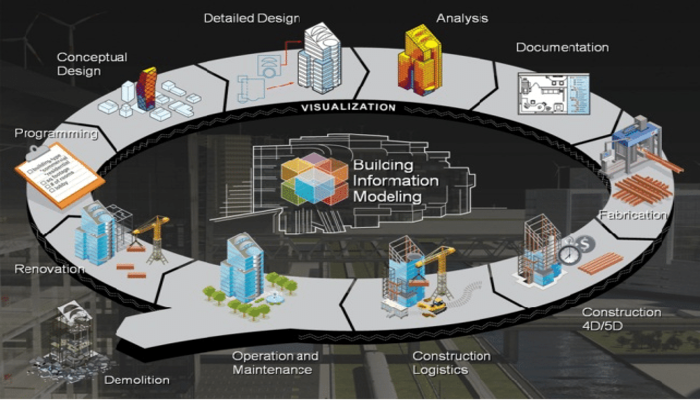
2. BIM Standards Shaping the Canadian Market
2.1. buildingSMART Canada as the National Standards Body
buildingSMART Canada (bSC) operates as a federally incorporated not-for-profit and serves as Canada's national authority on BIM and digital asset-lifecycle delivery standards. It advocates for open, interoperable data standards and coordinates initiatives such as its Municipal Infrastructure Council, which brings municipalities together to apply consistent BIM policy and OpenBIM standards on real public projects, rather than each jurisdiction reinventing its own framework independently.
2.2. ISO 19650: The De Facto Information Management Standard
Even without a legislated mandate, ISO 19650 has become the practical reference standard most Canadian BIM providers align their workflows to, covering:
- BIM Execution Plan (BEP) development
- Common Data Environment (CDE) structure and version control
- Naming conventions and Level of Development (LOD) verification
- Information handover and access-permission protocols
2.3. OpenBIM Adoption
To support projects with stakeholders on different software platforms — Autodesk Revit, Archicad, Tekla Structures, Bentley OpenBuildings, Vectorworks — Canadian firms increasingly rely on buildingSMART International's OpenBIM formats:
- IFC (ISO 16739) — vendor-neutral 3D model data exchange
- BCF (BIM Collaboration Format) — exchanging coordination issues without transferring full models
- IDS (Information Delivery Specification) — validating that a model meets defined information requirements
3. A Verified Shortlist: Top BIM Companies in Canada
The profiles below focus on established, publicly verifiable firms — either publicly traded, or with disclosed ownership structure, registered headquarters, and traceable project history. Figures are drawn from each company's official site, public corporate filings, or independent business registries (Wikipedia corporate records, PitchBook, ZoomInfo), and — as with any shortlist — should be reconfirmed directly with the provider before contracting, since headcounts and project totals change.
3.1. Stantec
Stantec is a publicly traded (TSX/NYSE: STN) engineering, architecture, and environmental consulting firm founded in 1954 in Edmonton, Alberta, where it remains headquartered. The company employs roughly 34,000 people across more than 450 locations on six continents, with reported 2024 revenue near CAD 6 billion. Stantec's digital delivery practice applies BIM (3D/4D modeling), GIS, and — through its Stantec.io platform — Digital Twin and smart-infrastructure tools across its Infrastructure, Water, Buildings, and Energy & Resources business units.
- Core BIM services: BIM Strategy, Infrastructure BIM, Civil BIM, BIM Management, Digital Delivery
- Verification: Publicly traded company (TSX: STN, NYSE: STN); financials and headcount independently reported via PitchBook and public filings
- Website: stantec.com
3.2. WSP Canada
WSP Global is a publicly traded (TSX: WSP) professional services firm headquartered at 1600 René-Lévesque Boulevard West, Montreal, Quebec. Its current structure traces to Quebec-based Genivar, which acquired the UK's WSP Group in 2012 and reorganized as WSP Global Inc. in 2014. As of early 2026 the company reported more than 80,000 employees operating in over 50 countries, with 2024 revenue exceeding CAD 16 billion. WSP's Canadian operations serve transportation, infrastructure, buildings, and environmental sectors, applying BIM alongside Digital Twin and asset-information-management services.
- Core BIM services: BIM Consulting, BIM Coordination, Digital Engineering, Digital Twin, Asset Information Management
- Verification: Publicly traded company (TSX: WSP); part of the S&P/TSX 60 index
- Website: wsp.com
3.3. PCL Construction
PCL is a 100%-employee-owned general contracting group headquartered in Edmonton, Alberta, with a US head office in Denver, Colorado. Its roots trace to 1906, and it was incorporated as Poole Construction Company Limited in 1913. PCL reports more than 10,000 employees (including hourly tradespeople) across Canada, the United States, Australia, and the Caribbean, and was named a Platinum Club member in Canada's Best Managed Companies program for 24 consecutive years as of 2025. PCL applies Virtual Design & Construction (VDC), BIM-based 4D scheduling, 5D cost management, and digital-twin tools for asset lifecycle management on its construction projects.
- Core BIM services: VDC, Construction Simulation, BIM Coordination, Clash Detection, 4D Scheduling, 5D Cost Management
Verification: 100% employee-owned structure and Best Managed Companies recognition independently reported - Website: pcl.com
3.4. EllisDon
EllisDon is an employee-owned, integrated construction services company founded in 1951 in London, Ontario, and now headquartered in Mississauga, Ontario. The company reports roughly 5,000–5,700 employees across offices on six continents. EllisDon's Virtual Design and Construction (VDC) teams apply Scan-to-BIM modeling, reality capture (laser scanning and drone-based point cloud registration), and model coordination across healthcare, education, and commercial project sectors.
- Core BIM services: Construction BIM, VDC, Scan to BIM, Reality Capture, Digital Twin
- Verification: Registered headquarters address publicly listed; employee-owned structure disclosed
- Website: ellisdon.com
3.5. AECOM Canada
AECOM Canada is headquartered in Markham, Ontario, and operates as the Canadian subsidiary of AECOM (NYSE: ACM), a publicly traded infrastructure consulting firm headquartered in Dallas, Texas. While AECOM Canada's corporate roots (through predecessor firms such as Proctor & Redfern) trace back over a century, its current entity was formalized in 1999–1990. AECOM Canada has delivered BIM-based digital engineering for major national infrastructure, including the Gordie Howe International Bridge and Toronto's Ontario Line, and the wider AECOM organization has publicly documented BIM-based project delivery internationally, integrating architectural, structural, and process-equipment models on complex facilities.
- Core BIM services: Digital Engineering, Digital Twin, Smart Infrastructure, Asset Management
- Verification: Publicly traded parent company (NYSE: ACM); named infrastructure projects independently reported by regional business press
- Website: aecom.com
3.6. Hatch
Hatch is a private, employee-owned engineering and management consultancy founded in 1955 in Toronto and now headquartered in Mississauga, Ontario. It reports more than 10,000 staff across 70-plus offices in over a dozen countries, with a project history concentrated in mining, metals, energy, and heavy industrial infrastructure. Hatch has publicly stated its focus on combining BIM with AI and digital engineering tools to improve design coordination and project management efficiency on complex industrial projects.
- Core BIM services: Industrial BIM, Digital Engineering, AI-assisted design coordination
- Verification: Employee-owned structure and headcount independently reported (Wikipedia corporate record, ZoomInfo)
- Website: hatch.com
3.7. Comparison Table
| Company | Founded | HQ | Ownership | Core BIM Focus |
| Stantec | 1954 | Edmonton, AB | Public (TSX/NYSE: STN) | Infrastructure & Civil BIM, Digital Delivery |
| WSP Canada | 1959 (as Genivar) | Montreal, QC | Public (TSX: WSP) | BIM Consulting, Digital Twin |
| PCL Construction | 1906 | Edmonton, AB | 100% Employee-owned | VDC, 4D/5D BIM |
| EllisDon | 1951 | Mississauga, ON | Employee-owned | Construction BIM, Scan to BIM |
| AECOM Canada | 1990/1999 | Markham, ON | Subsidiary of public parent (NYSE: ACM) | Digital Engineering, Digital Twin |
| Hatch | 1955 | Mississauga, ON | Employee-owned | Industrial BIM, AI-assisted design |
Due diligence note: Even among large, well-documented firms, headcount and revenue figures vary between sources and reporting dates. Before engaging any of the firms above — or comparing them against a broader list of BIM companies in Canada — request current certifications, ask for verifiable named project references, and confirm registered corporate details via Corporations Canada or the relevant provincial business registry, plus a Google Maps listing that matches the stated office address.
4. How to Choose the Right BIM Company in Canada
The list above is a reference point, not a ranking — company size or brand recognition alone does not determine fit for a specific project. Evaluate prospective BIM companies in Canada against the following criteria:
4.1. Technical Capability
Confirm practical, demonstrable experience in the specific BIM disciplines the project needs: Architectural BIM, Structural BIM, MEP BIM, Civil BIM, Clash Detection, BIM Coordination, Scan to BIM, 4D BIM, and 5D BIM — not simply a general claim of "BIM experience."
4.2. Standards and Information Management
For projects involving international stakeholders, confirm the provider's working familiarity with ISO 19650, IFC, OpenBIM, CDE structuring, BEP development, and LOD-based information delivery requirements.
4.3. Project Experience Relevant to Scope
Assess experience by project type, scale, and complexity relevant to the specific deliverables required — a firm with thousands of completed projects in one sector is not automatically the right fit for a project outside that sector.
4.4. QA/QC and Model Validation
A professional BIM provider should be able to describe a defined Quality Assurance / Quality Control workflow: naming-convention compliance, LOD verification, multidisciplinary clash-detection rounds, and IFC/OpenBIM interoperability testing before handover — not a single informal review pass.
4.5. Coordination and Communication
For multi-country, multidisciplinary projects, communication quality and time-zone workability can matter as much as raw modeling capability, particularly where a client team in North America or Europe is coordinating daily with an outsourced production team.
5. Notes When Placing a Custom BIM Outsourcing Order
Before signing a scope of work with any BIM provider — Canadian or otherwise — confirm the following in writing:
- LOD definition per deliverable. Specify Level of Development (LOD 100–500) for every discipline and phase; "BIM modeling" alone is not a specification.
- File format and software version. Confirm the native Revit version, IFC export requirements, and whether BCF is required for issue tracking.
- Common Data Environment (CDE) access. Clarify who hosts the CDE and how version control and access permissions work across time zones.
- Turnaround time per revision cycle, not just an overall project deadline — this determines how mid-project coordination bottlenecks are handled.
- Named point of contact and escalation path for the full engagement, not only during the sales process.
- IP ownership and confidentiality terms, particularly on government, healthcare, or infrastructure-security-sensitive projects.
6. Frequently Asked Questions
Is BIM legally required on construction projects in Canada? No. Canada has no single national BIM mandate. However, agencies such as Public Services and Procurement Canada and Defence Construction Canada, along with a growing number of provincial and municipal owners, require BIM in tender documents for major projects — so in practice, BIM has become a competitive necessity on large public work even without a nationwide law.
Which BIM standard should a Canadian project follow if there's no legal mandate? ISO 19650 has become the de facto reference standard used by most established Canadian BIM providers, even in the absence of legislation, because it is internationally recognized and expected by clients in the UK, US, and elsewhere.
Is BIM outsourcing from outside Canada (e.g., Vietnam) a credible alternative to hiring a Canadian firm directly? Yes, provided the outsourcing partner can demonstrate ISO 19650-aligned workflows, a verifiable company registration, and named client references — the same due-diligence standard that should be applied to any domestic or international BIM provider, as outlined in Section 4.
Should project size or brand recognition be the deciding factor? No. As outlined in Section 4, the right partner is the one whose technical capability, QA/QC discipline, and communication fit match the specific project — not necessarily the largest firm on the shortlist.
DHA ENGINEERING — Your International BIM Outsourcing Partner
While many project owners and contractors evaluate BIM companies in Canada for their next project, DHA ENGINEERING offers a comparable alternative built on the same standards discussed throughout this article — ISO 19650-aligned information management, disciplined QA/QC, and transparent, verifiable project documentation — delivered from a Vietnam based BIM engineering team.
DHA Vietnam Engineering Co., Ltd. provides BIM Consulting and MEPF Engineering services for international clients, supporting projects from organizational BIM readiness assessment and BIM Execution Plan development through to full-lifecycle information management. The company's services span architectural, structural, and MEP BIM modeling, clash detection, and construction documentation for hospitality, commercial, educational, and mixed-use developments, both within Vietnam and for overseas clients.
Rather than competing purely on cost, DHA ENGINEERING applies the same evaluation standard outlined in Section 4 of this article to its own operations: verifiable company registration, disciplined coordination workflows, and a named, responsive point of contact throughout the engagement — the standard international clients should expect from any BIM outsourcing partner, whether based in Canada, India, Vietnam, or elsewhere.
DHA Vietnam Engineering Co., Ltd.
Tax Code: 0108366698
Address: No. 03, Alley 322/17/72, My Dinh Street, Tu Liem Ward, Hanoi, Vietnam
Email: contact@dha-engineering.com
Hotline: +(84) 868 248 333
Website: https://dha-engineering.com/
This article is intended for informational and procurement-guidance purposes. Company data such as employee counts, certifications, and project totals should be reconfirmed directly with each provider, as these figures change over time.
Dong Anh Integrated Primary School
Fusion Saigon Centre - 5 Star hotel
See more
BIM Application in Construction: Benefits, Levels, and Implementation Process
main.comment_read_more